


I run local AI models for every coding task I do. Not because cloud AI is bad or incapable — but because for the way I work as a WordPress developer, local AI makes more financial sense, offers better privacy for client code, and avoids locking me into a single provider that can change prices or terms at any time without notice.
As a WordPress developer, I do not write code every single day. Some days are spent on content entry for client sites, having meetings about project requirements, handling server maintenance and updates, running performance tests, writing documentation, and all the other tasks that come with running a solo web development practice. Paying a monthly subscription to OpenAI, Anthropic, or any other cloud AI provider means paying for a service that I might use intensively for a week then barely touch for the next two weeks. That recurring cost adds up quickly, especially when you factor in the currency exchange rate from the Algerian dinar to the US dollar.
The Real Cost of Cloud AI Subscriptions in Algeria
A ChatGPT Plus subscription at 20 USD per month works out to roughly 2,800 DA at current exchange rates. A Claude Pro subscription at the same price is another 2,800 DA. If I subscribe to both for different task types — one for coding assistance and another for content work — that is 5,600 DA per month going out consistently every month regardless of whether I used the services or not. For a solo developer whose monthly income varies with project flow and payment schedules, that fixed recurring cost is significant compared to other business expenses like hosting and domain renewals.
The cost of a single cloud AI subscription per month can equal or exceed what I pay for hosting multiple client sites. I would rather put that money toward better hosting infrastructure or invest the time in building more custom plugins that reduce my development time on future projects. Local AI completely removes this recurring cost from my budget. The software tools like Ollama and LM Studio are free and open source. The models themselves are free to download and use. The only expense is the electricity to run them on hardware I already own and use for development work. Once a model is downloaded to my machine, I can use it as much as I want with no usage limits, no token count restrictions, and no surprise price increases when the provider decides to restructure their pricing.
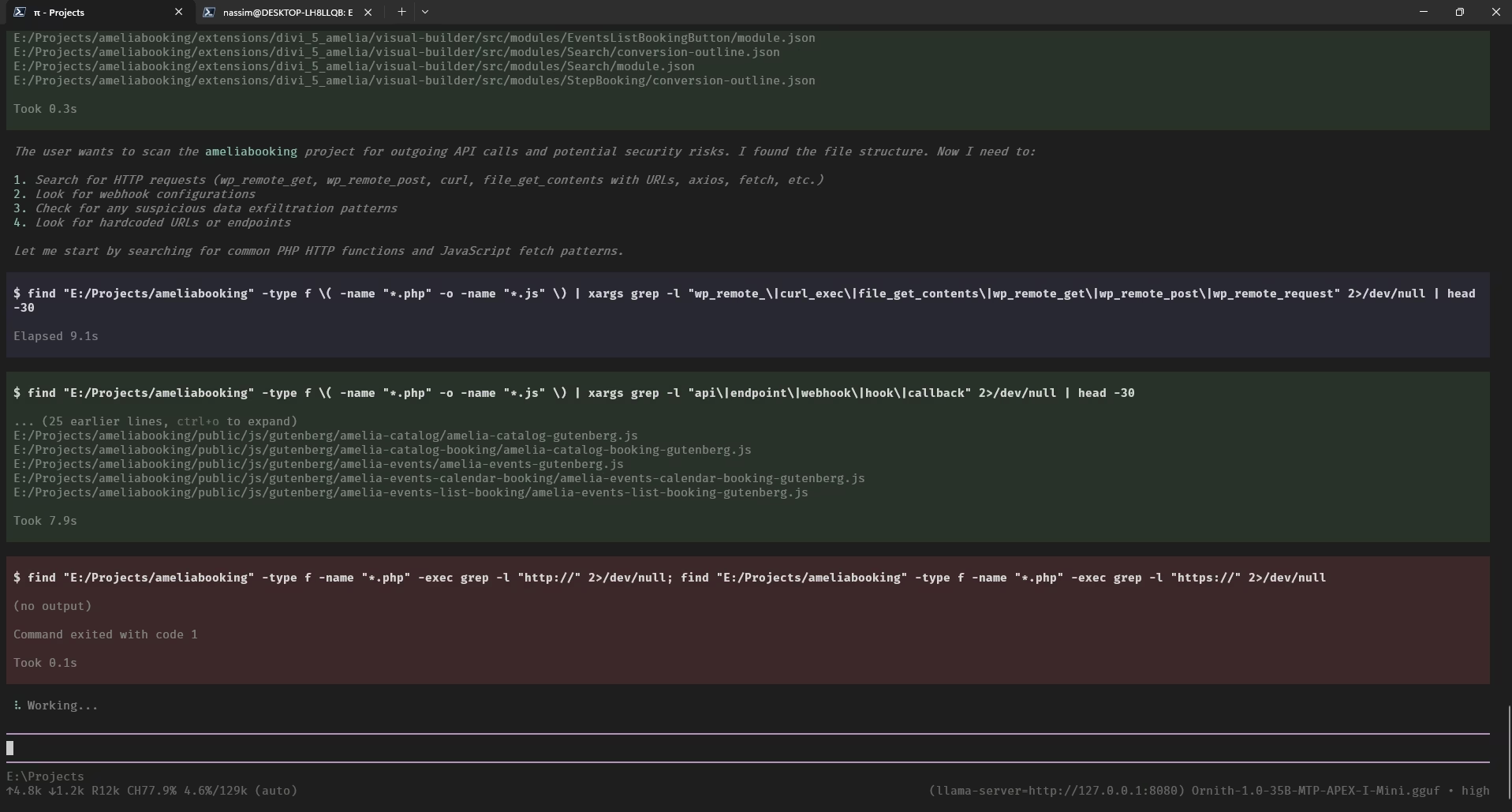
The Vendor Lock-In Problem That Nobody Talks About
Relying on a single cloud AI provider creates a subtle dependency that I have seen cause real problems for other developers I know. The provider updates their underlying model, and the code that generated perfectly working output last month now produces something completely different because the new model behaves differently. The provider changes their pricing page, and the monthly cost doubles without warning. The provider experiences a regional outage, and I am sitting idle waiting for their servers to come back online before I can debug an urgent client issue or finish a task that I need to ship the same day.
Local AI eliminates all of these concerns in one stroke. The model I use today will produce the same output next month because it is running on my machine, not on a server that someone else controls and can modify at any time. If I want to switch to a newer or better model, I download it, test it side by side with my current model on the same prompts, and decide which one to use going forward. No trial period to rush through, no contract to cancel, no migration of API integration code required. I can run multiple different models on my machine at the same time and pick the best one for each specific task without any provider lock-in or switching cost.
The Privacy Advantage for Client Work
Client code frequently contains sensitive information that should not be transmitted to any third party. Database credentials in configuration files. Proprietary business logic that is specific to a client’s workflow and represents their competitive advantage. Unpublished features under development that should not be visible to anyone outside the project team. Sending that code to a cloud AI provider means trusting their data handling and privacy policies, even if they claim not to train their models on API inputs. Running the model locally on my own hardware means the code never leaves my machine under any circumstances, and there is no privacy policy to trust or distrust because the question never arises.
My Take
Local AI is not some futuristic concept to look forward to years from now. It is the practical, cost-effective present for any developer who wants capable AI assistance without recurring subscription costs, provider dependency, or privacy concerns for client work. Cloud AI services have advantages in raw model capability and larger context windows for complex tasks. For the daily work of a WordPress developer — generating plugin boilerplate and functions, debugging PHP errors, writing Gutenberg block code, composing documentation and content — local models like Qwen 2.5 Coder and Gemma 4 deliver everything I need without any of the downsides of cloud subscriptions. The combination of zero ongoing cost, complete privacy, full control over which model I run and when I switch, and offline availability when the internet is unreliable makes local AI the obvious choice for daily development work. Cloud subscriptions still make sense for occasional heavy tasks that need more capability. But for regular daily use, the local option is better in every practical dimension that matters to a solo developer working with client code.
For the complete 3-model stack with launch commands, see My 3-Model Local AI Stack: Fast Worker + Coder + Senior Planner.